Projects
Here are our projects! All of them are open-source, so you can inspect the code and see how they work. If you like any of them and want to participate, feel free to contact us through each project's GitHub repository. There’s always room for improvement or bugs to uncover, so we’re looking forward to having you onboard!
HTTP RetroServer
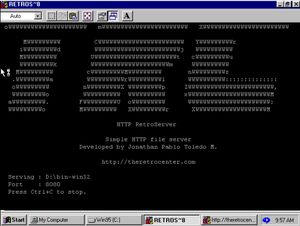
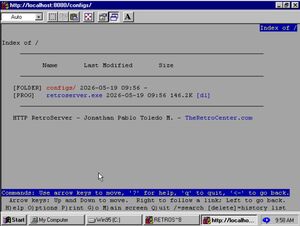
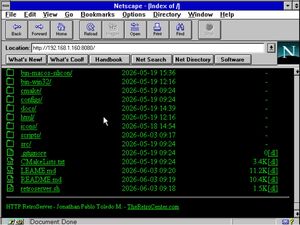
A lightweight HTTP static file server written in C. Designed for maximum retro compatibility, the directory listing works on browsers as old as Internet Explorer 3.0 and Lynx, with a phosphor green terminal aesthetic. Runs on Linux, macOS, and Windows 95 through Windows 11.
Boat Rudder
Boat Rudder is a backward-compatible content management system (CMS) that was born in response to the need to connect early 90s computers to the Internet. Through a server-side rendering strategy, Boat Rudder detects when a request is made from an old computer or internet browser and responds with a website containing a set of HTML, CSS, and JavaScript codes compatible with the era of the requesting device. The management of this compatibility has been divided into the following three eras:
|

|
|
|
|
- Epoch 0 (Pre-standard): Plain text browsers before web standards (Lynx, Cello, Line Mode Browser).
- Epoch 1 (Born): Basic HTML templates for early browsers with no CSS or JavaScript (NCSA Mosaic, Internet Explorer 1-2, Netscape 1-2-3).
- Epoch 2 (Early): HTML2 templates for early modern era browsers (e.g., Internet Explorer 3.0, Netscape 4.0).
- Epoch 3 (Modern): HTML5 and CSS3 templates for modern browsers (e.g., Google Chrome 90+, Microsoft Edge, Mozilla Firefox 90+)
- Epoch WML (WAP): WML support for WAP 1.x browsers. Compatible with WinWAP, UP.Browser and mobile phones from the late 90s / early 2000s.
This project is under development; we haven't released a beta test yet.
Remote-Controlled Terrain Drone with Camera
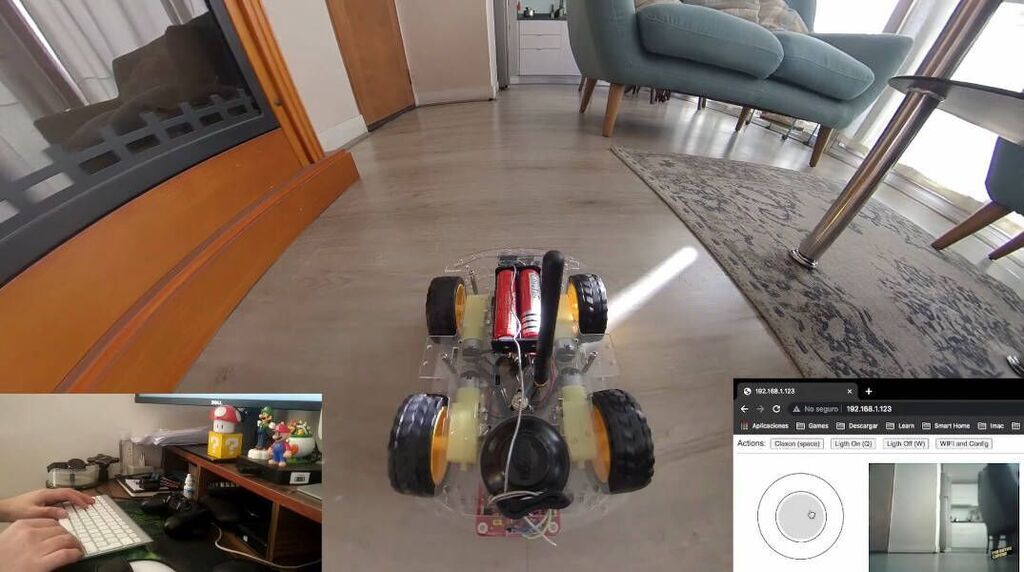
This project is a remote-controlled vehicle (drone) that takes full advantage of the features of the ESP32-CAM microcontroller, such as Wi-Fi and Bluetooth connectivity. It also streams real-time images captured by its camera, allowing the vehicle to be controlled without the need for direct visual contact.
You can connect the vehicle to your home Wi-Fi network or use the network provided by the microcontroller itself. Once linked to the vehicle, you have multiple control options: via a website, the Android mobile app we’ve developed, or the API made available by the vehicle.